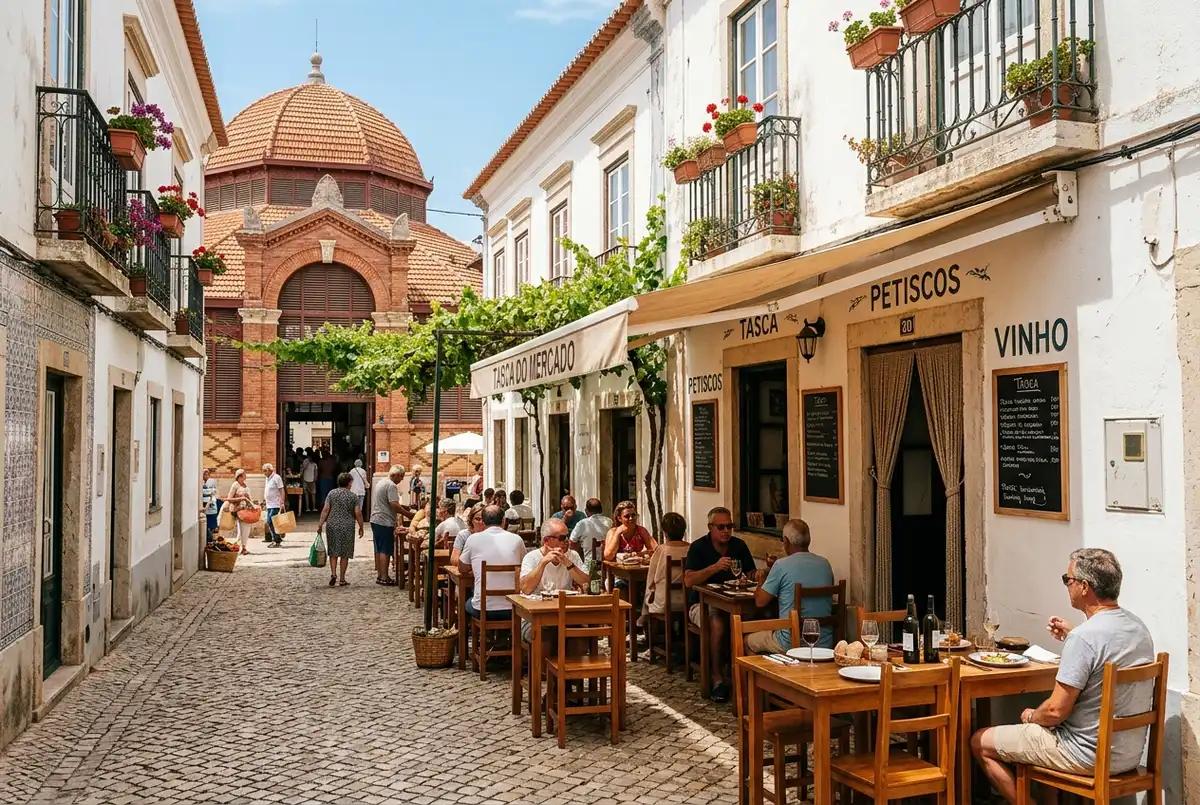
Loule restaurants are best found around two anchors: the town’s beautiful covered market, and the tangle of old town streets just beyond it, where family-run tascas have been feeding locals for decades. I’d treat Loule as the inland food detour that rewards travelers who’d rather eat where residents eat than pick from a beachfront tourist menu, and honestly, it’s one of the better reasons to leave the coast for an afternoon.
Why Is Loule Known for Its Food Scene?
Loule sits inland from the Algarve’s beach resorts, and that distance is exactly why its food culture stayed more traditional. The town built its reputation around its historic covered market and the weekly Saturday market, both of which pull in local producers selling cheese, cured meats, fresh fish, and produce that ends up on the plates of the restaurants surrounding them.
I’d say this is the honest version of Algarve cooking, less adapted for a tourist palate than what you’ll find in some of the busier coastal resort towns. If you want to taste the region the way locals actually eat, Loule is where I’d point you first.
What’s the Best Area in Loule to Find Restaurants?
The streets immediately around the Mercado Municipal de Loule, the town’s striking Moorish-influenced covered market building, hold the highest concentration of good, casual eating options. I’d start here and simply wander, since this pocket of the old town rewards walking more than pre-planning a specific address.
A short walk further into the old town’s narrow, whitewashed streets turns up smaller, quieter tascas that don’t always carry much of an online presence but are usually full of locals at lunchtime, which I’d treat as the best possible sign. If a place is packed with residents rather than tourists at 1pm on a weekday, that tells you more than any review ever could.
Are There Good Traditional Portuguese Tascas in Loule?
Yes, and this is genuinely where Loule earns its reputation. A tasca, in Portuguese, is a small, informal, family-run restaurant serving simple, hearty regional dishes, grilled fish, cataplana seafood stew, pork with clams, at honest prices, and Loule’s old town has a real concentration of them.
I’d specifically look for places with a short, handwritten daily menu rather than a laminated multi-page one aimed at tourists, since that’s usually a reliable sign of a kitchen cooking what’s fresh that day rather than reheating from a freezer. Where to eat in Loule really comes down to following that instinct through the old town streets rather than chasing a specific pinned location.
Is the Loule Market a Good Place to Eat, Not Just Shop?
Absolutely, and I’d build real time into a visit specifically for this. The covered market itself sells fresh produce, cheese, bread, and cured meats you can assemble into an excellent impromptu lunch, while the surrounding stalls and small cafes serve prepared food, grilled sardines, pastries, coffee, right at the market’s edge.
On Saturdays, the wider gypsy market spreading out around the covered building adds food stalls of its own into the mix, along with clothing, crafts, and household goods. I’d time a Loule food trip around a Saturday morning specifically if your schedule allows it, since the atmosphere alone makes the detour worthwhile even before you’ve eaten anything.
Where Can You Get Good Seafood in Loule Despite Being Inland?
Loule sits far enough inland that it isn’t a fishing town itself, but its proximity to the coast means fresh catch reaches its restaurants and market stalls daily. I’d still expect excellent grilled fish and seafood cataplana here, just sourced rather than landed locally, which honestly makes little practical difference on the plate.
If fresh-off-the-boat seafood specifically matters to you, I’d actually pair a Loule food stop with a coastal town like Carvoeiro or Alvor on the same trip rather than treating Loule as your only seafood destination. Our where to eat in Carvoeiro guide covers a genuinely coastal alternative if that’s your priority.
Are There Good Cafes in Loule for Breakfast or Coffee?
Yes, and I’d say this is an underrated reason to base a morning here before heading to the coast. Small cafes cluster around the market and the main old town square, serving strong Portuguese coffee alongside pastries like pastel de nata, and a few offer a proper cooked breakfast if you want something more substantial before a day of sightseeing.
I’d sit outside if the weather allows it, since watching the old town wake up around the market is genuinely one of the more pleasant low-key mornings you can build into an Algarve itinerary, and it costs almost nothing beyond the price of a coffee.
Is Loule Good for a Family Meal?
Yes, generally. The old town’s tascas tend to be casual, unhurried, and welcoming to children, without the formality that can make a family meal feel stressful elsewhere. I’d specifically look for places with outdoor seating on a quieter side street if you’re eating with young kids, since it gives everyone a bit more room without disturbing other diners.
Portion sizes at traditional tascas also tend to run generous, which I’ve found works well for families happy to share a couple of larger dishes rather than ordering individual mains for everyone at the table.
Does Loule Have Fine Dining Options Too?
Yes, alongside its casual tascas, Loule’s old town also holds a handful of more polished restaurants aimed at a slower, special-occasion meal, often with a modern take on traditional Algarve ingredients. I’d book ahead for these specifically, since the good ones fill up, particularly on weekend evenings.
That said, I’d honestly steer most visitors toward the casual tascas over fine dining here, since Loule’s real strength is unpretentious, ingredient-driven cooking rather than a formal tasting menu experience you could find in any major city.
Is Loule Worth a Detour from the Coast Just for the Food?
Yes, I genuinely think so, provided you’re already planning to spend more than a single day in this part of the Algarve. Loule isn’t a beach town, so I wouldn’t recommend it as your only stop, but as a half-day addition built around a market morning and a proper old-town lunch, it earns its place on an itinerary.
I’d pair it naturally with a Benagil Caves day, honestly, since the drive between the two is short and it turns a single-attraction outing into a fuller day that covers both the coast and a genuinely different, more local side of the Algarve.
How Does Loule Compare to Alvor or Carvoeiro for Eating Out?
Alvor and Carvoeiro both lean coastal and seafood-heavy, with waterfront restaurants built around a harbor view, while Loule leans inland and market-driven, with its strength in tascas and produce rather than a sea view. I’d choose Loule if authentic, unfussy Portuguese cooking matters more to you than eating with your feet in the sand, and Alvor or Carvoeiro if the coastal setting is part of the meal itself.
Our where to eat in Alvor guide covers that coastal alternative in full, if you’re weighing a seaside dinner against Loule’s old-town charm for a specific evening of your trip.
What Should You Order in Loule?
Cataplana, a seafood or meat stew cooked and served in a distinctive copper clam-shaped pot, is the dish I’d point first-time visitors toward, since it’s genuinely a regional specialty rather than something invented for tourists. Grilled fish, simply prepared with olive oil and lemon, and pork dishes reflecting the Algarve’s inland farming tradition alongside its coastal seafood, round out what I’d call the essential Loule plate.
Local cheese and cured meats from the market stalls make an excellent lighter alternative if a full sit-down meal doesn’t fit your schedule, and honestly, assembling your own market-stall lunch is one of my favorite lower-key ways to spend an hour in this town.
Practical Tips for Eating Out in Loule
I’d carry some cash, since smaller family-run tascas in the old town don’t always have reliable card readers, particularly the smallest, most local spots. Lunch service tends to run earlier than many visitors expect, roughly 12:30 to 2:30pm, with a similar dinner window from around 7pm, so I wouldn’t count on finding a hot kitchen much outside those hours at the smaller places.
Saturdays bring the biggest crowds thanks to the market, which I’d treat as a genuine reason to arrive early rather than a reason to avoid the day entirely, since the atmosphere is honestly worth the extra bustle.
What’s the History Behind Loule’s Food Culture?
Loule grew as an inland market town rather than a coastal fishing settlement, and that history shaped its food culture in a specific way: a stronger emphasis on farming, cured meats, and cheese alongside the seafood that reached it from the coast. I’d say this inland farming heritage is exactly what gives Loule’s cooking its slightly different character from the beach towns nearby, more hearty stews and slow-cooked dishes, less purely grilled-fish focused.
The covered market building itself, with its distinctive Moorish-influenced architecture, has anchored this food culture for generations, and I think that continuity is part of why the town’s restaurants still lean so heavily on genuinely local, seasonal ingredients rather than a standardized tourist menu. Walking through the market on a weekday morning, watching stallholders arrange the day’s produce, gives you a real sense of where the surrounding restaurants’ ingredients actually come from.
Is Loule Busy with Tourists, or Still a Local Town?
Compared to the Algarve’s coastal resort towns, Loule stays noticeably more local, even with the Saturday market drawing a real crowd of visitors. I’d say weekday mornings and afternoons in particular still feel like a working town going about its business rather than a destination built primarily around tourism.
This matters directly for where to eat, since it means the restaurants here haven’t shifted their menus and pricing as heavily toward visitor expectations as some coastal spots have. I’d treat that as a genuine point in Loule’s favor if you’re looking for food that reflects the region rather than a menu translated into six languages with photos of every dish.
What’s a Realistic Half-Day Food-Focused Itinerary in Loule?
I’d start with a slow morning coffee and pastry at one of the cafes near the market square, followed by an hour or so wandering the covered market itself, picking up a few things to taste, cheese, cured meats, fresh bread, even if you’re not building a full picnic. From there, a proper sit-down lunch at a tasca in the old town rounds out the visit, ideally timed for the earlier end of the lunch window before the busiest tables fill.
If you’re visiting on a Saturday specifically, I’d add the wider gypsy market into that same morning, since the food stalls there add a genuinely different, more casual grazing option alongside the sit-down tasca lunch. This whole loop comfortably fills three to four hours without feeling rushed, which I’d say makes Loule a natural half-day stop on a longer Algarve itinerary rather than a full-day destination on its own.
Are There Vegetarian Options in Loule Restaurants?
Traditional Algarve cooking leans heavily toward meat and seafood, so I wouldn’t say vegetarian options are the headline strength of Loule’s tascas specifically. That said, the market itself is an excellent resource for vegetarian travelers, with genuinely good fresh produce, cheese, and bread available to assemble a satisfying meal without relying on a restaurant menu at all.
Some of the more modern restaurants in the old town do offer a wider range of vegetarian dishes alongside the traditional meat and seafood options, so I’d ask directly or check a menu in advance if this matters to your trip, rather than assuming every tasca will have much beyond a simple salad.
Is Loule Better for Eating Out Than Coastal Resort Towns?
For authentic, unfussy Portuguese cooking at fair prices, yes, I’d say Loule genuinely outperforms the busier resort strips further along the coast, where a beachfront location alone can inflate a menu’s prices without necessarily improving the food. Loule’s restaurants compete on quality and local reputation rather than sea views, which tends to keep standards, and value, higher.
I wouldn’t call this an absolute rule, since good coastal restaurants certainly exist too, but I’d trust a full tasca in Loule’s old town over a half-empty beachfront terrace almost every time. Crowds of locals at lunch are a better signal here than a prime waterfront location.
Pricing reflects this difference too. A cataplana or grilled fish dish in Loule’s old town generally costs noticeably less than the same dish served with a view over the water in a busier resort town, without any real drop in quality. I’d factor that gap into your daily food budget if you’re splitting your trip between the coast and this inland detour.
My Recommendation
I’d build a Loule food stop around the Saturday market if your schedule allows it, arriving hungry, wandering the covered market and surrounding streets, and picking a tasca that’s already full of locals rather than one you researched in advance. That instinct rarely steers you wrong in this town.
For the coastal counterpart to this inland food detour, our where to eat in Carvoeiro and where to eat in Alvor guides cover the seafood-forward dining you’ll find right on the water. Our Algarve towns roundup covers how Loule fits alongside the coastal bases if you’re still deciding where to spend your time on this trip.
According to Turismo do Algarve, the official regional tourism board, Loule’s covered market and its weekly gypsy market rank among the region’s most authentic traditional experiences, which lines up with what I’d tell any visitor weighing whether the inland detour is worth it.
Frequently Asked Questions
Where is the best area to eat in Loule?
Around the covered market, Mercado Municipal de Loule, and the surrounding old town streets, where family-run tascas concentrate.
Is Loule good for authentic Portuguese food?
Yes. Loule’s inland, market-driven food culture stayed more traditional than some busier coastal resort towns, making it a strong pick for authentic cooking.
Is Loule Market open every day?
The covered market runs daily, with a much larger weekly gypsy market adding food and craft stalls every Saturday.
Is Loule worth visiting just for the restaurants?
As a half-day addition to a longer Algarve trip, yes. I wouldn’t make it your only stop, since it isn’t a beach town, but it’s a strong pairing with a coastal day.
Do Loule restaurants take card payments?
Many do, but I’d still carry cash, since smaller, family-run tascas don’t always have reliable card readers.
benagil caves →