Benagil Caves Facts: History & the Story Behind the Name
See prices From 12 EUR · Free cancellation available
Contents
The Benagil cave, formally Algar de Benagil, sits beside a small fishing village that most of the millions who now recognize its skylight from a photo have never actually heard named. I think that gap, between the cave’s global fame and the quiet history behind it, is genuinely worth closing before you visit, since it changes how the trip feels once you’re actually there.
What Is the Benagil Cave, Exactly?
Algar de Benagil is a sea cave carved into limestone cliffs on Portugal’s Algarve coast, distinguished by a near-perfect circular opening in its collapsed roof that lets daylight pour straight down onto a chamber of sand below. The Benagil cave only opened to the water, no path connects the clifftop to the cave floor, which is part of why it stayed a local secret for so long before cameras found it.
I’d call it a genuinely rare formation rather than just another sea cave along this coastline. The circular skylight, roughly the shape of a dome with its top sliced clean off, is what separates it from the dozens of smaller grottoes nearby, several of which sit close enough to visit on the same boat route.
Check prices & dates
Ready to visit?
Book your tickets in advance: popular time slots sell out.
Thousands of years of Atlantic wave action wore through the region’s soft limestone from sea level upward, hollowing out a chamber whose roof grew thinner and thinner until it eventually gave way, leaving the circular skylight visible today. This is the same erosion process that shaped sea caves and arches all along the Algarve’s southern coast, just carried further here than almost anywhere else nearby.
I find it worth pointing out that this formation is still an active, moving system, not a fixed museum piece. Waves keep working the rock every day, which means the cave you see today isn’t frozen in the state it was photographed in a decade ago, and it won’t stay exactly as it is now either.
Where Does the Name Benagil Come From?
Honestly, there’s no single documented origin that I’d point to with full confidence. Benagil is the name of the small fishing village that sits just around the headland from the cave, and the cave itself simply carries the village’s name, the way most Algarve sea caves are named for the nearest settlement rather than for any specific legend.
I’d treat any confident-sounding story claiming a precise etymology with some skepticism, since the Algarve carries centuries of overlapping Arabic, Portuguese and older place-name layers from its long Moorish-influenced history, and small village names like this one often don’t have a single clean, verified record explaining their roots. What I can say is that the village came first, by generations, and the cave inherited its name from it, not the other way around.
Is Benagil an Old Fishing Village?
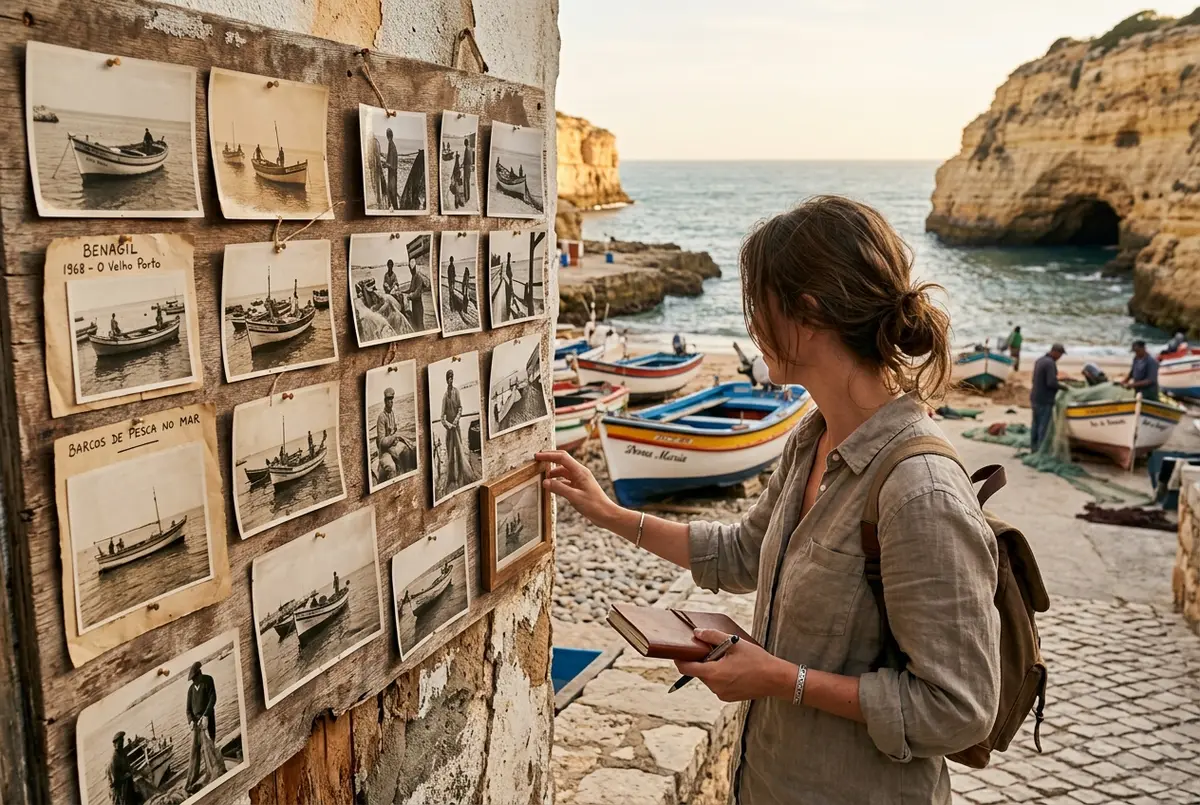
Yes, genuinely so. Long before the skylight showed up on anyone’s camera roll, Benagil was, and to a real extent still is, a working fishing settlement, small enough that you can walk its clifftop in a few minutes, with local boats still pulled up on the sand of the village beach below.
I think that working-harbor backdrop is easy to miss once you’re focused on the cave itself, but it’s genuinely part of what makes the wider area worth understanding, not just photographing. Our Praia de Benagil guide covers the village beach itself and the fishing-harbor character that still shapes it today, in more depth than a single paragraph here ever could.
When Did the Benagil Cave Become Famous?
Relatively recently, in the scale of the cave’s own history. Photos of the skylight, that circular shaft of light landing on golden sand, began spreading widely online through the 2010s, and the pace accelerated fast once travel and photography accounts on social platforms picked it up. What had been a known local spot for boat operators and a handful of curious travelers turned into an internationally recognized bucket-list stop within a relatively short stretch of years.
I’d genuinely call this one of the clearer examples of a single striking photograph reshaping a small place’s entire tourism economy. Boat and kayak operators in Portimao and Benagil village scaled up specifically to meet the demand that followed, and the crowding you’ll read about in trip reports today traces almost directly back to that viral moment rather than to any change in the cave itself.
What Makes the Benagil Cave Different from Other Sea Caves Nearby?
The circular skylight is the real answer here. Plenty of sea caves dot the Algarve coastline, including several within the same short boat route as Algar de Benagil, but almost none share its specific geometry, a roof that collapsed into something close to a perfect circle rather than a jagged, irregular opening.
I’d say that’s exactly why this one specific cave became the icon and its neighbors, several of which are genuinely striking too, stayed comparatively obscure. Our Benagil sea caves guide covers the Cathedral Cave and the other formations along the same stretch if you want the fuller cluster picture beyond the one famous shot.
Is the Benagil Cave a Protected Natural Site?
It sits within the Algarve’s broader coastal conservation framework, and access rules, particularly around drone use and, at times, direct swimming near the cave mouth, have tightened as visitor numbers grew. I wouldn’t call it a heavily fenced or ticketed nature reserve in the way some protected sites are run, but I’d still treat it with real respect, since it’s a natural formation, not a built attraction, and it’s still actively shaped by the same erosion that created it.
I think that distinction matters more than most first-time visitors realize going in. There’s no entry gate and no ranger checking tickets, but the fragility of an actively eroding limestone roof is a genuinely good reason to follow whatever local guidance a tour operator or posted signage gives you.
Do Facts About the Benagil Cave’s Size Get Exaggerated?
Sometimes, yes, mostly because a wide-angle drone shot compresses scale in a way that flatters the cave’s actual dimensions. It’s genuinely impressive in person, the domed chamber and the skylight both read as larger and more dramatic from inside a small boat than most people expect from photos, but I wouldn’t walk in expecting a cathedral-sized cavern either.
I’d set that expectation honestly rather than let a heavily edited photo do the talking. The scale that matters most is the one you experience from water level looking up, and that view, in my opinion, doesn’t need any exaggeration to land.
Is the Benagil Cave Worth Visiting Given Its History?
Yes, and knowing the backstory genuinely adds something a first-time visitor without any context would miss. Benagil cave facts like the recent viral history and the working-village setting reframe the visit as something more than a photo stop, a place with a real, fairly short, and specific story behind why it looks the way it does and why so many people now show up to see it.
For the fuller expectation-setting version of whether the trip lives up to the reputation, our Are the Benagil Caves Worth Visiting? guide covers crowds, cost and timing in full.
My Recommendation
I’d go into a Benagil cave visit knowing three things: it’s a genuinely rare geological formation, not a manufactured attraction, it only found global fame in the last decade or so, and the fishing village next door has a longer, quieter history than the photos ever show. That context, in my experience, makes the actual visit land differently than showing up cold with only a single Instagram shot as a reference point.
For the full trip-planning picture beyond just the history, our Benagil Caves guide pillar covers formation, timing and photography in one place, and our Benagil Caves Tours comparison is the natural next stop once you’re ready to actually book a way to see it.
According to Turismo do Algarve, the official regional tourism board, Algar de Benagil ranks among the most visited natural landmarks on the entire Algarve coast, a fairly remarkable outcome for a formation that most of the world only learned the name of within the last decade.
Frequently Asked Questions
What is the Benagil cave, exactly?
Algar de Benagil is a sea cave on Portugal’s Algarve coast with a collapsed roof that formed a near-perfect circular skylight, named for the small fishing village beside it.
How old is the Benagil cave?
The cave formed over thousands of years of Atlantic wave erosion. Its global fame, by contrast, is recent, dating mostly to the 2010s once photographs began circulating widely online.
Where does the name Benagil come from?
There’s no single confirmed origin. The cave takes its name from the small fishing village of Benagil beside it, in keeping with how most Algarve sea caves are named for their nearest settlement.
Was Benagil always a tourist destination?
No. It was a working fishing village for generations before the cave’s skylight went viral online and turned it into an international bucket-list stop within a relatively short span of years.